
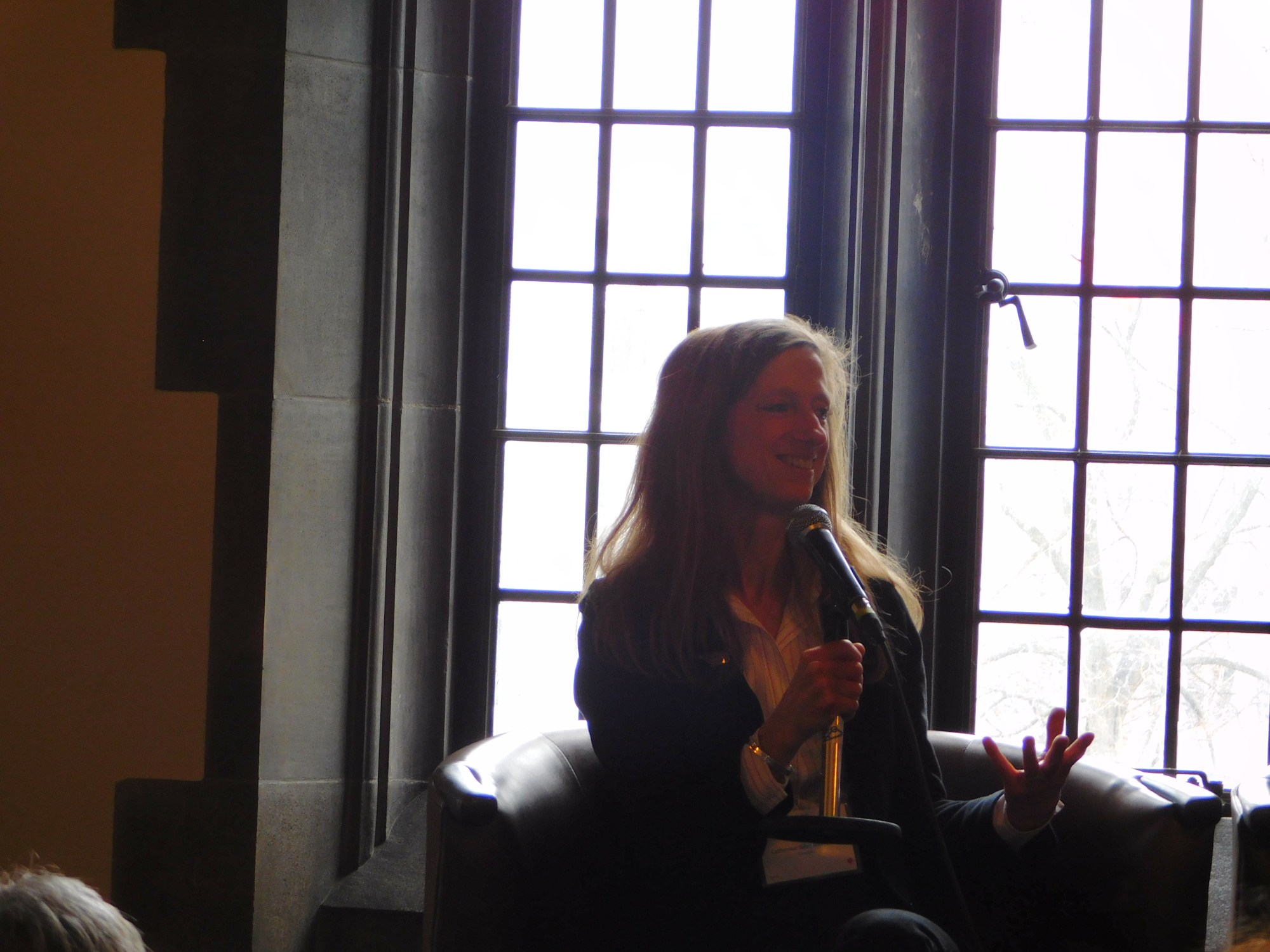
(The Rev. Dr.) Catherine Sider Hamilton is Assistant Professor in New Testament and Greek at Wycliffe College in the University of Toronto, and Priest-in-Charge, St. Matthew’s Anglican Church, Riverdale. In addition to her work on Matthew and on Paul, she has a particular interest in women of the early church. She has written short articles on Egeria, Marcella and Paula for Marion Taylor’s Handbook of Women Biblical Interpreters and the entry on Egeria for De Gruyter’s Encyclopedia of the Bible and Its Reception; she is now working with Prof. Taylor on a book surveying women’s readings of Paul through the ages: Paul and Women through the Ages.
Quotes by Catherine Sider Hamilton from WomenTalk:
“Perpetua is the sort of early Church woman who inspires me…she had no hesitation in claiming Paul’s words for her words, in accepting the role of prophet that her brother and the Church community gives to her and then in either speaking or writing her account to be left as a witness. The editor who introduces it says that her new witness is just as important as the books of the scriptures. She leaves her account as a witness like Paul’s letters.”
“In Genesis, God makes humankind in His image – male and female…humankind singular so it seems to me there is a kind of distinction and unity that are both proper to being human. So that who we are as both male and female is important – that we don’t want to just blur it together – men and women – they are unique and important in their differences. But also that they’re equally important. It is the two things together side by side that are the image of God”
“There is an interesting moment in Perpetua. At the end of her diary she relates her last dream vision in which she conquers the massive Egyptian – she hits him in the face and steps on his head in her dream vision. But before she does this, she strips down like a gladiator would and is oiled all over her body as she says “facta sum masculus”. That’s an impossible statement in Latin because the verb facta is feminine and masculus is masculine. So she, Perpetua, still a woman, is somehow made a male. So in that moment, I think of Genesis. Not that there’s an androgyny at all but that both the male and female are equally represented in her triumph over the power of the state.”
 Celebrating Women in Theology